
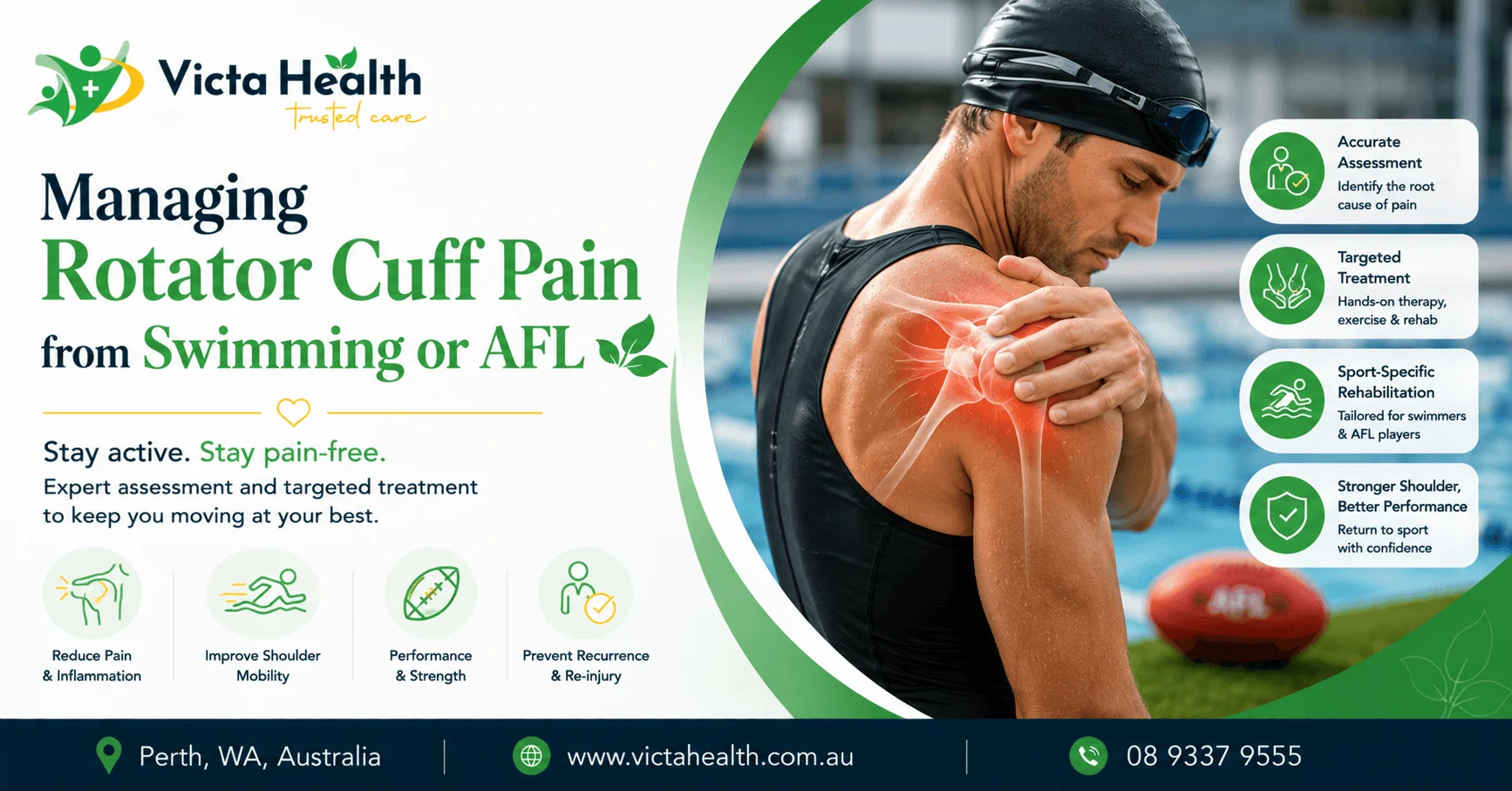
Managing Rotator Cuff Pain from Swimming or AFL
Perth’s active lifestyle often revolves around heavy overhead movements, whether it is swimming freestyle laps in the Indian Ocean or raising your arms for a spectacular AFL mark. Unfortunately, these repetitive, high-impact motions place immense stress on the complex group of muscles stabilizing your shoulder. Ignoring early rotator cuff pain can quickly turn a minor case of inflammation into a complete muscle tear that requires surgery.
Understanding the Shoulder Joint
Your shoulder is incredibly mobile, but that extreme range of motion makes it inherently unstable and prone to overuse injuries.
The Mechanics of the Cuff
The rotator cuff is a group of four small muscles and tendons that hold the “ball” of your upper arm bone securely within the shallow “socket” of your shoulder.
- Example: Think of your shoulder joint like a golf ball sitting on a small tee; the rotator cuff muscles act as the tight elastic bands keeping that ball from falling off when you move your arm.
Repetitive Overuse and Impingement
When these small muscles become fatigued from repetitive overhead activity, they swell and get pinched (impinged) between the bones of the shoulder blade.
- Example: Pushing through a 2km ocean swim with fatigued shoulders, causing the inflamed tendon to scrape painfully against the bone with every single stroke.
Clinical Signs You Need an Assessment
Shoulder soreness after a long game is normal, but specific mechanical symptoms indicate structural tissue damage.
The Painful Arc
Experiencing a sharp, catching pain only during a specific middle portion of lifting your arm out to the side.
- Example: Reaching up to grab a heavy dinner plate from the top kitchen cabinet and feeling a sudden, sharp pinch halfway through the movement.
Nighttime Aching
Inflamed shoulder tendons tend to throb intensely when the body is at rest, frequently disrupting your sleep cycle.
- Example: Rolling onto your affected shoulder while sleeping and waking up immediately with a deep, radiating ache traveling down your bicep.
Frequently Asked Questions
How long does it take for a rotator cuff to heal?
It depends entirely on the severity. A mild strain can resolve in 2 to 4 weeks, while a partial tear can take several months of dedicated clinical rehabilitation.
Should I put my arm in a sling?
No. Completely immobilizing the shoulder for prolonged periods can lead to a condition called “frozen shoulder,” where the joint capsule thickens and severely restricts all movement.
Can a GP diagnose shoulder pain?
Yes. Your doctor will perform specific physical resistance tests to isolate the torn muscle and can provide a rapid referral for a diagnostic ultrasound to view the tendons.
Is swimming bad for my shoulders?
Swimming is excellent for joint health, but poor stroke mechanics combined with fatigued muscles is the leading cause of overhead shoulder impingement.
Book Your Perth Shoulder Assessment
Do not let rotator cuff pain keep you out of the water or off the field. Book a clinical assessment at our sports injury clinic in Perth today. Our GPs will accurately diagnose the source of your impingement and build a comprehensive rehabilitation plan to ensure a safe return to sport.
Medical Disclaimer
For educational purposes only. Consult a GP at Victa Health for a personalized assessment regarding your specific shoulder symptoms, imaging needs, and injury rehabilitation.